

XD1
A bilingual website for a company that sells software audits and AI-assisted delivery — nine pages in English and nine in Romanian, every figure linked to its source
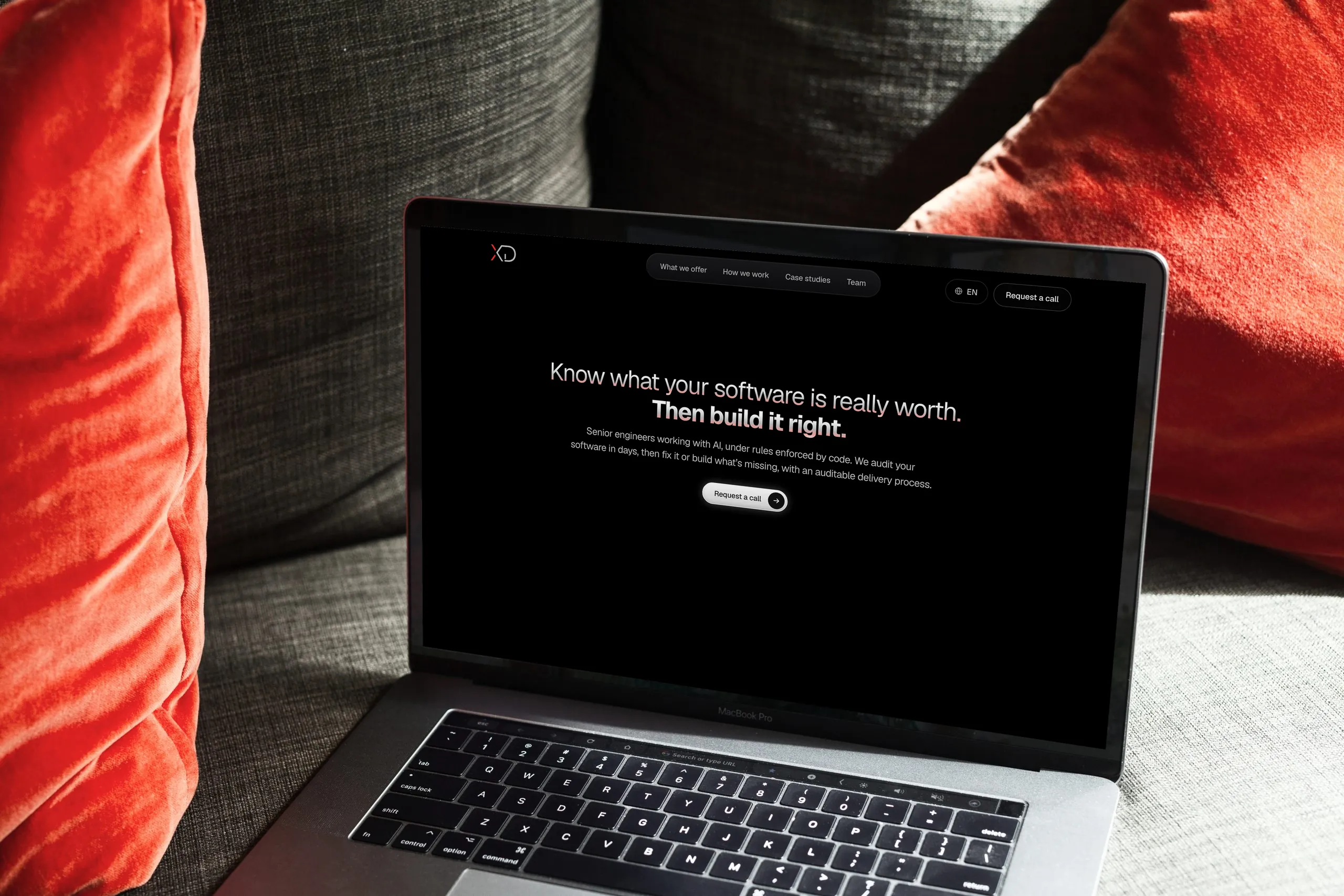
XD1 is a small team of senior engineers who audit software, then fix what is broken or build what is missing. They work with AI, but under rules enforced by code, and every step of delivery leaves evidence. Their clients are executives at software companies and digital businesses, including in regulated sectors.
For this audience, a website is not a brochure. It is the first proof that the team follows its own rules: if you sell discipline and measurement, you cannot have a site that promises into thin air.
We built the site from scratch: nine pages in English and nine in Romanian, with their own URLs in each language, a public page where every figure on the site shows its source and the month it was measured, and a single next step for the visitor.





The challenge
XD1 sells exactly what the market fears most: software written with the help of AI. The objection shows up in the first thirty seconds — “and how do I know it will turn out right?” The site had to answer it before the first call, not during it.
This audience does not read much: CEOs and CTOs facing a big decision — an investment, a rebuild, a new team. They check fast and they leave fast.
Concretely, the site had five things to solve at once:
- two different services — assess and build — explained without forcing the visitor to choose on the first screen;
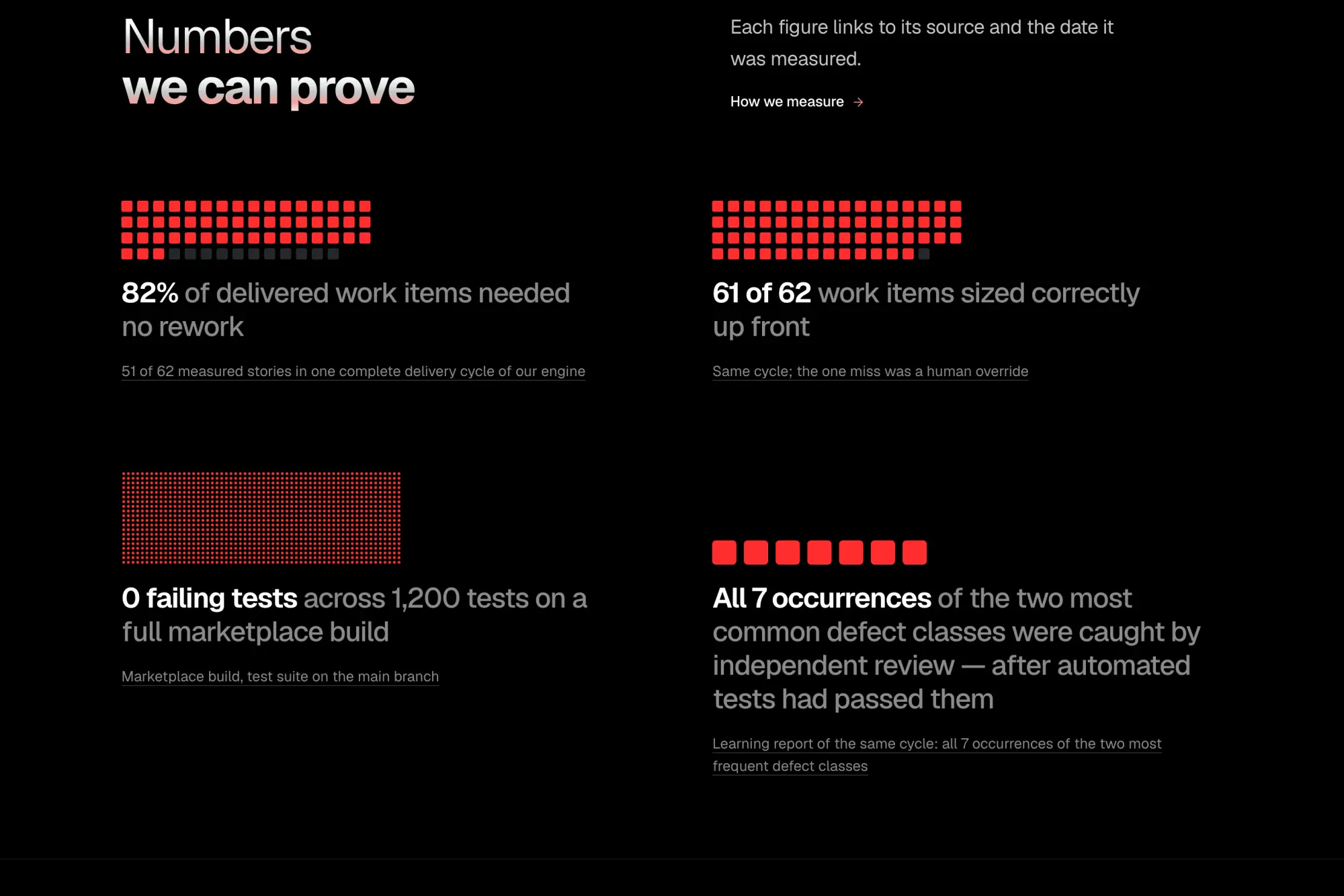
- figures the reader has no way of verifying: 82% of work items delivered without rework, 1,200 tests, none failing;
- case studies without the client's name — XD1 does not publish names without written consent, so the proof had to come from somewhere else;
- two languages, for an international audience and a local one, without either being a token translation of the other;
- nothing that asks the visitor for data the site does not need: for someone at a regulated company, a tracking script and a cookie banner are an objection in themselves.
The solution
Two services on the same page, with no forced choice
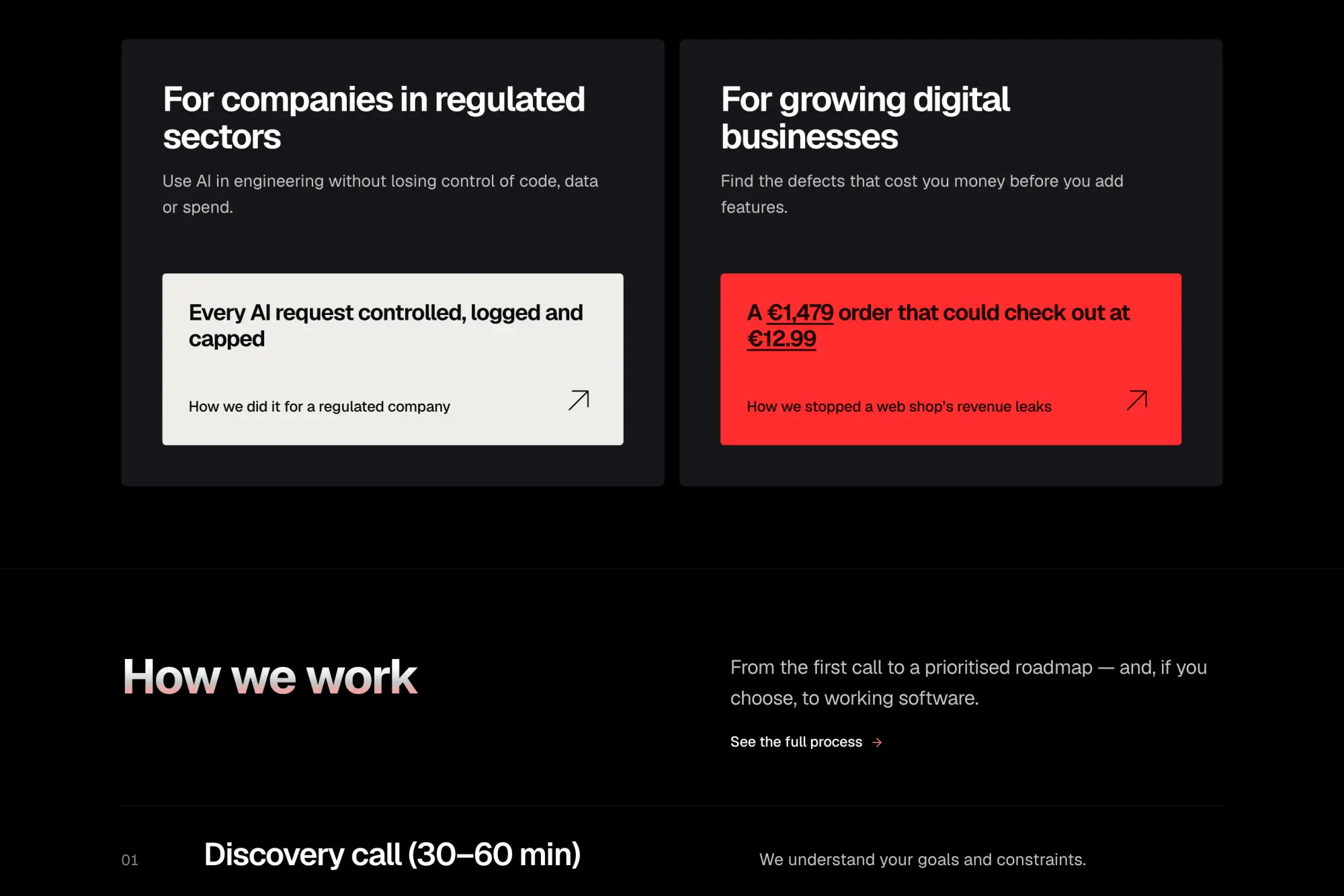
Assess and Build sit side by side, as two panels the visitor switches between. Each says the same thing in the same order: what you get and what we ask of you. The pair appears identically on the home page and on the services page, so the answer is the same wherever someone lands from a search.
The order of the offer is written into the page: assess first, build second, and only if the findings justify it. That promise lowers the perceived risk, so we let it show on the first screen.
Every figure links to its source
A band on the home page collects the figures the team can prove, and each one carries its source underneath: the measured delivery cycle, the test suite, the learning report.
Further down, a whole page — “How we measure” — takes them one by one, in a three-column table: the figure on the site, its source, and the month it was measured. The same page states that the figures are refreshed quarterly.
The effect is simple: a claim nobody can verify becomes a dated claim with a source. For a technical reader, that is the difference between an ad and a report.
Case studies without the client's name
XD1 does not publish client names without their written consent, so the cards cannot lean on logos. We moved the weight onto the finding: the title of the case study is the defect itself — a 1,479 EUR order that could check out at 12.99 EUR — and the company name is replaced by its field: a regulated company, a growing online store.
Two case studies are told end to end, and a third, shorter one sits on the home page as an example of a roadmap on three horizons: quick wins in days, fixes in weeks, a platform upgrade over a quarter.
Two languages, each with its own URLs
English sits at the root, Romanian under /ro/, and the Romanian URLs are in Romanian: /ro/servicii/, /ro/cum-lucram/, /ro/studii-de-caz/. Every page declares its counterpart through hreflang, including the default variant, and the links are written into the sitemap as well.
The language switch leaves you on the same page instead of sending you back to the home page. For someone reading a case study in Romanian, that means carrying on rather than starting over.
One single next step, with no form
The site has a single call to action, repeated at the end of every page: a discovery call. There is no form. The button opens an email that is already written, with a subject line and three lines to fill in — the company, the main technologies, the decision ahead.
The visitor fills in no fields, and the team receives a message that already has structure. The contact page shows the email address and the phone number in plain sight.
A static site, with no tracking and no cookie banner
The pages are generated before publication and served as ready-made files: the essential styles are written into the page, the font is hosted on the same domain and loaded early, and only two JavaScript files run on the home page. It is, above all, a decision about website speed.
There is no analytics script and no third-party cookies, so there is no cookie banner to accept either. For a visitor from a regulated company, that is not something missing — it is an argument.
Structured data and a team with names
Every page declares its structured data — the organization, the website, the page — and the frequently asked questions are marked as such, so they can appear in Google with their answers.
The team page puts five people on screen with name, role and experience, because that is what actually sells: not a platform, but a small senior team that has worked together for years.
Results
The site launched recently, so we are not crediting it with traffic figures that have not been measured. Here is what concretely changed for XD1:
- a complete bilingual site — nine pages in English and nine in Romanian, each with its own URL and its counterpart declared through hreflang;
- the offer explained in two steps, with what the client gets and what is asked of them, on the same page;
- every figure on the site carries its source and the month it was measured, on a public page;
- case studies that convince without the client's name, because the title is the finding;
- a single next step: an email that is already written, or a phone call — no form and no account;
- static pages, with no tracking and no cookie banner.
How we'll measure progress
The site has no analytics script, so progress is read from Google Search Console and from what lands in the inbox. We will complete this case study after the first few months.
The metrics we track:
- impressions, clicks and positions in Google, separately for English and Romanian;
- the pages that bring in the first searches — services, how we work, case studies;
- the number of discovery calls requested by email and by phone;
- the countries the searches come from, so we know whether a third language is worth it.
Do you run a company that sells in two languages, but a website that does not show it? See what a business website includes and what a web design project costs.
LET'S TALK ABOUT YOUR PROJECT

Send us a message 😉